




If you're researching Lever alternatives, there's usually a reason.
Maybe you need better reporting. Maybe you're looking for more advanced automation, built-in scheduling, stronger AI capabilities, or simply a platform that offers more value for the price.
The good news is that the ATS market has evolved significantly over the last few years. There are many strong alternatives to Lever, each with its own strengths depending on your hiring volume, team size, and recruiting goals.
Here are the best alternatives we came across for different recruiting team needs.
Why you might need a Lever alternative
Lever remains a popular ATS, particularly among mid-sized recruiting teams. Many users appreciate its combination of applicant tracking and CRM capabilities, along with its relatively intuitive day-to-day workflow.
That said, several recurring themes come up when recruiters evaluate alternatives to Lever.
1. High cost for growing teams
One of the most common drawbacks pointed out by many users was Lever’s cost. We found many users describing Lever as a premium-priced ATS, which can become difficult to justify as hiring teams scale.
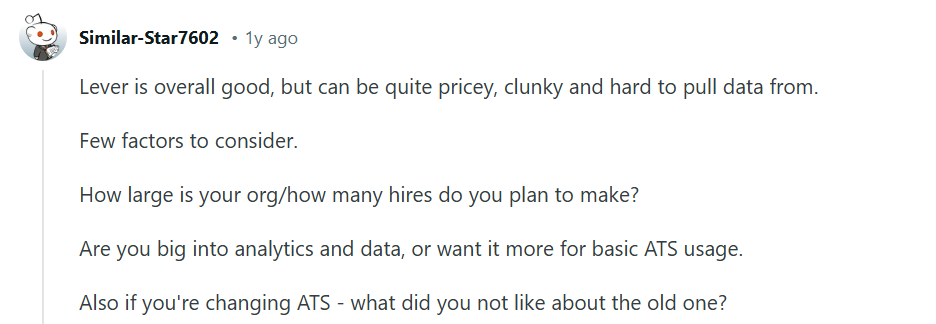
Some users report that the platform offers solid core functionality but becomes expensive compared to newer applicant tracking system tools that include more capabilities out of the box.
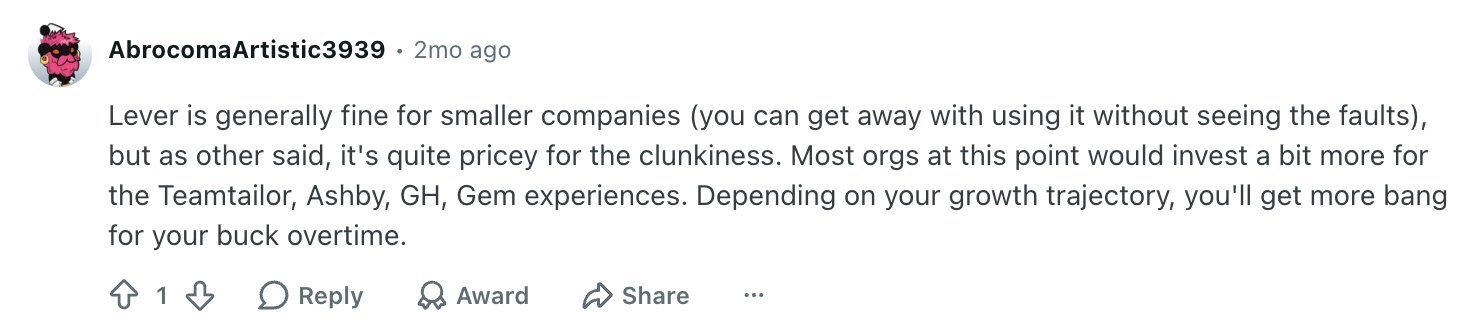
For organizations looking to maximize value, pricing is one of the most common reasons for exploring Lever alternatives.
2. Reporting and analytics can feel clunky
While Lever includes reporting capabilities, many users mention that extracting meaningful data isn't always straightforward. Custom reporting, advanced analytics, and exporting data often require additional workarounds, making it harder for recruiting leaders to get the insights they need quickly.
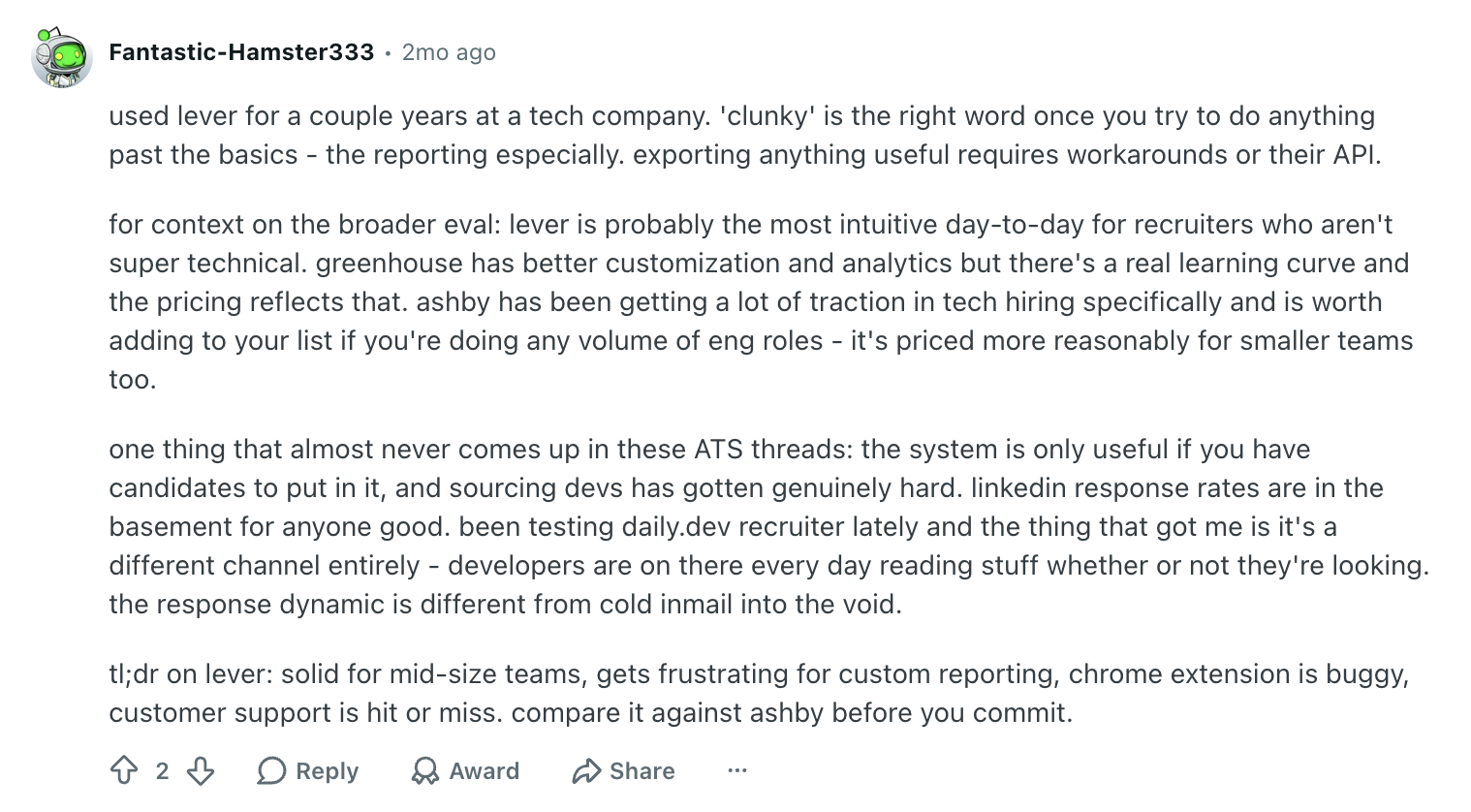
Teams that rely heavily on recruiting analytics often look for platforms with more flexible reporting and dashboard capabilities.
3. Advanced functionality often comes at an additional cost
Several features that larger recruiting organizations consider essential may require additional purchases, integrations, or higher-tier plans. As hiring processes become more sophisticated, these extra costs can add up quickly and increase the total cost of the ATS pricing.
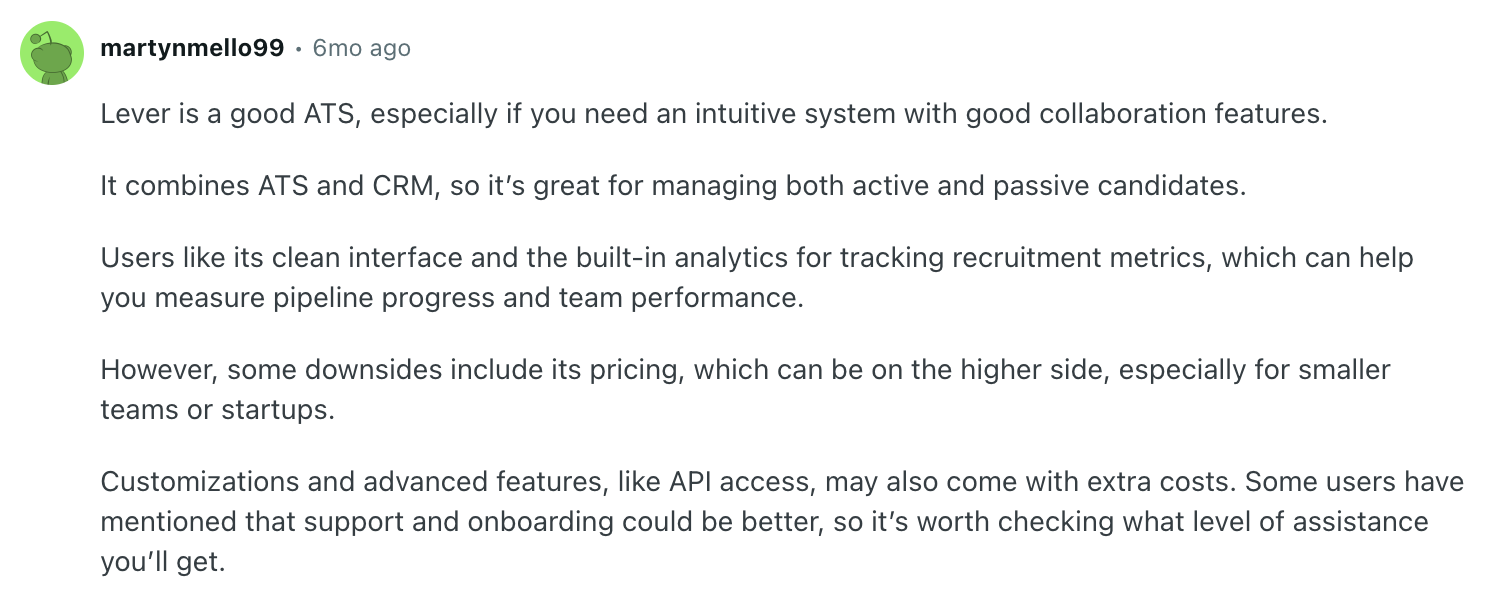
For teams trying to consolidate their recruiting tech stack, this can be a significant drawback.
4. Limited customization for complex recruiting workflows
Lever works well for many standard hiring processes, but some users find its customization options limiting as their recruiting operations mature. Organizations with unique workflows, reporting requirements, approval processes, or interview structures may need greater flexibility than Lever currently provides.
This is particularly important for high-growth companies and recruiting teams with more complex hiring operations.
How we compared the best Lever alternatives: Our methodology
There are dozens of applicant tracking systems in the market today, so we wanted to avoid creating another generic "best ATS" list.
We started by analyzing hundreds of user reviews, recruiter discussions, ATS recommendation threads, product documentation, pricing pages, and conversations with our own in-house sales teams and recruiting teams evaluating alternatives to Lever.
From there, we shortlisted the platforms that appeared most frequently in buyer evaluations and addressed the common reasons teams outgrow Lever, such as reporting limitations, pricing concerns, add-on costs, and customization requirements.
Once shortlisted, each platform was evaluated using a weighted scoring framework based on the areas that matter most to recruiting teams:
- Core recruiting functionality (25%): Candidate management, CRM capabilities, sourcing workflows, interview scheduling, collaboration features, and overall ATS depth.
- Workflow efficiency and usability (20%): Ease of navigation, recruiter adoption, speed of execution, and reduction of manual work.
- Customization and scalability (15%): Support for custom workflows, permissions, approval processes, interview structures, and growing recruiting teams.
- Analytics and reporting (15%): Reporting depth, dashboard flexibility, hiring insights, and visibility into recruiting performance.
- Automation and AI capabilities (10%): Practical AI functionality across screening, scheduling, reporting, sourcing, and workflow automation.
- Implementation and onboarding (10%): Migration complexity, learning curve, setup effort, and ongoing maintainability.
- Pricing and value (5%): Pricing transparency, add-on costs, scalability, and overall return on investment.
Rather than ranking tools solely on feature count, we focused on assessing platforms that actually solve the specific challenges that cause recruiting teams to start looking for Lever alternatives.
The best Lever alternatives: A quick look
- BreezyHR: Best for Small to mid-sized businesses that want an easy-to-use ATS with built-in automation, candidate communication, and collaborative hiring workflows.
- Kula: Best for teams that want an all-in-one, AI-native recruiting platform that combines ATS, CRM, sourcing, automated interview scheduling, interview intelligence, candidate evaluation, analytics, and offer management into a single system.
- Greenhouse: Best for mid-sized to enterprise organizations that want highly structured hiring processes, interview consistency, standardized scorecards, with a focus on overall HR processes.
- Workable: Best for small to mid-sized businesses that want an easy-to-use ATS with built-in HR functionality, transparent pricing, and fast implementation.
- Ashby: Best for scaling companies that want highly customizable recruiting workflows, advanced analytics, and a single platform for recruiting operations.
- JazzHR: Best ATS for small businesses and early-stage companies that want an affordable ATS with straightforward hiring workflows and minimal setup requirements.
- Jobvite: Best for enterprise organizations that need recruitment marketing and internal mobility capabilities
7 best Lever alternatives to try in 2026
1. BreezyHR
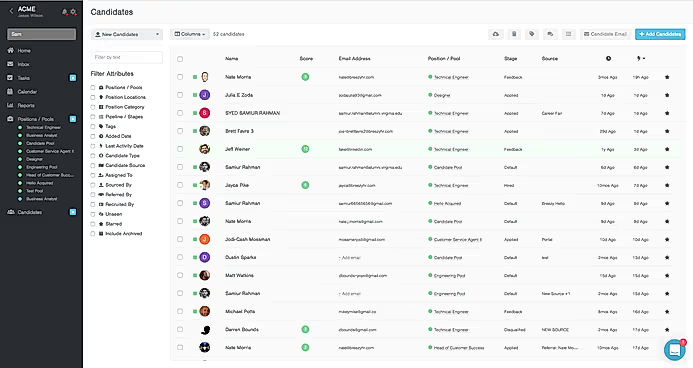
One thing I noticed while researching BreezyHR is that it solves a very different problem than Lever.
Lever is built for teams that want a combination of ATS and CRM functionality, with a strong focus on sourcing, talent pipelines, and candidate relationship management.
BreezyHR, on the other hand, prioritizes simplicity. The platform focuses on helping smaller recruiting teams move candidates through the hiring process with as little administrative work as possible.
Compared to Lever, BreezyHR feels lighter, easier to learn, and significantly more approachable for teams that don't have dedicated recruiting operations support. It’s pretty easy to use with the drag-and-drop pipeline, automated workflows, and candidate communication tools as major strengths.
I also found that BreezyHR puts a strong emphasis on candidate experience. Features like self-scheduling, SMS messaging, automated follow-ups, and customizable career sites help reduce the back-and-forth that often slows down hiring.
That said, BreezyHR is still primarily designed for SMB hiring workflows. As hiring volumes grow and recruiting processes become more complex, some teams report limitations around reporting depth, customization, and advanced workflow flexibility.
Key features:
- Automated recruiting workflows: Automate repetitive tasks such as candidate screening questions, interview reminders, feedback collection, disqualification workflows, and follow-ups.
- Candidate communication tools: Built-in email and SMS messaging helps recruiters communicate with candidates without relying on separate tools.
- Interview scheduling and self-scheduling: Candidates can book interview slots themselves, reducing recruiter coordination and scheduling delays.
- Career site builder and job distribution: Publish jobs to multiple job boards and create branded career pages without requiring technical support.
- Collaborative hiring: Centralize scorecards, interview feedback, comments, and hiring decisions in one place.
Pros:
- Easy to learn and implement
- Modern, intuitive user interface
- Strong candidate communication capabilities
- Built-in SMS messaging and scheduling tools
- Free plan available for smaller teams
- Faster implementation than many enterprise ATS platforms
Cons:
- Reporting and analytics can feel limited as hiring complexity grows
- Customization options aren't as extensive
- May feel restrictive for larger recruiting teams with more sophisticated workflows
Pricing:
- Free plan available with paid plans starting from $157/month.
G2 rating: 4.3/5
Why choose BreezyHR over Lever?
- Lower cost and transparent pricing
- Easier learning curve for smaller teams
- Stronger candidate communication through built-in SMS functionality
- Faster implementation with less administrative overhead
- Better fit for organizations that primarily rely on inbound hiring rather than talent pipelining
Bottom line:
BreezyHR is a strong Lever alternative for smaller teams that want a simpler, more affordable ATS without sacrificing core recruiting functionality. It does an excellent job handling applicant tracking, candidate communication, scheduling, and collaborative hiring.
But if your recruiting strategy depends heavily on sourcing passive candidates, building long-term talent pipelines, or managing complex recruiting operations, Lever's ATS + CRM approach will likely scale better over time.
2. Kula
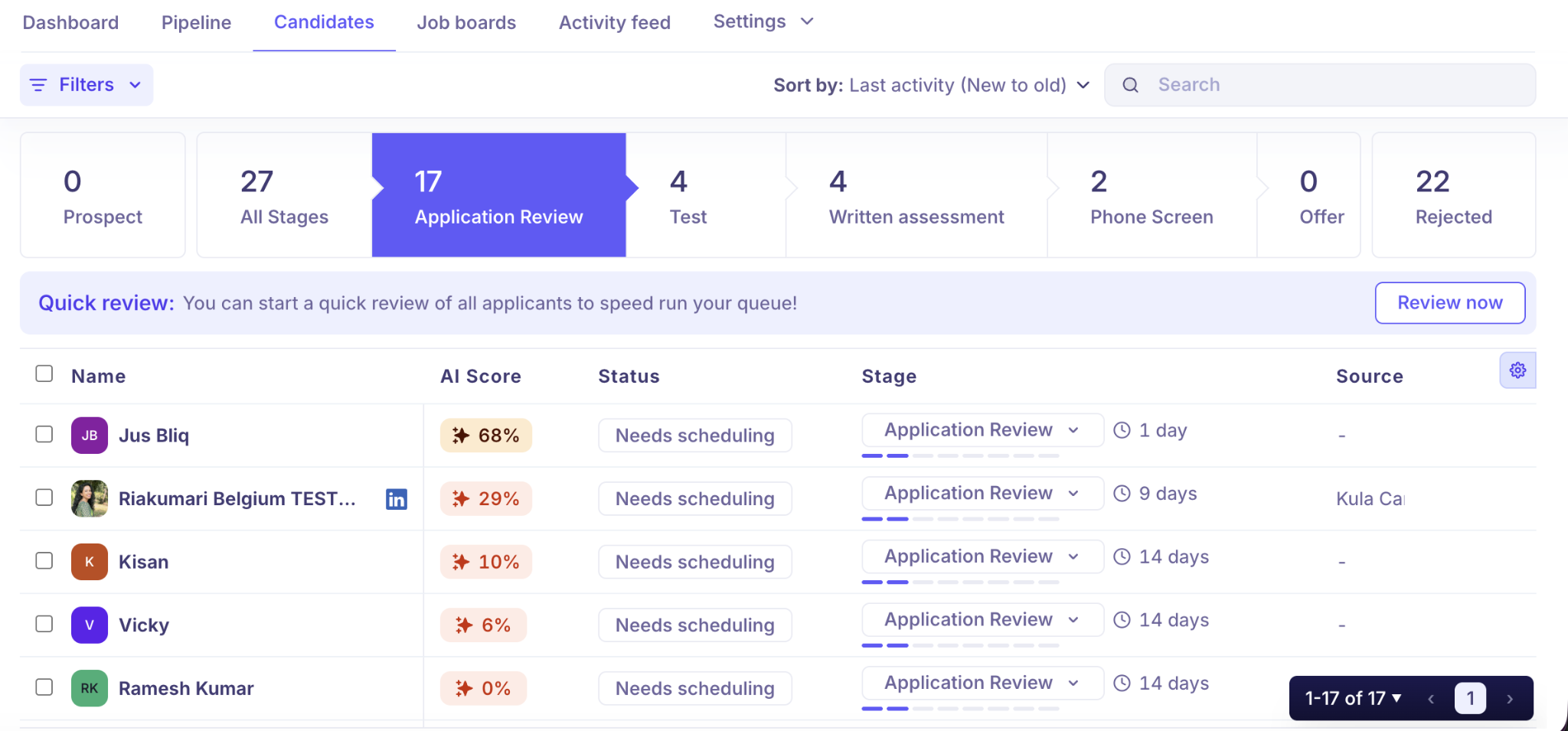
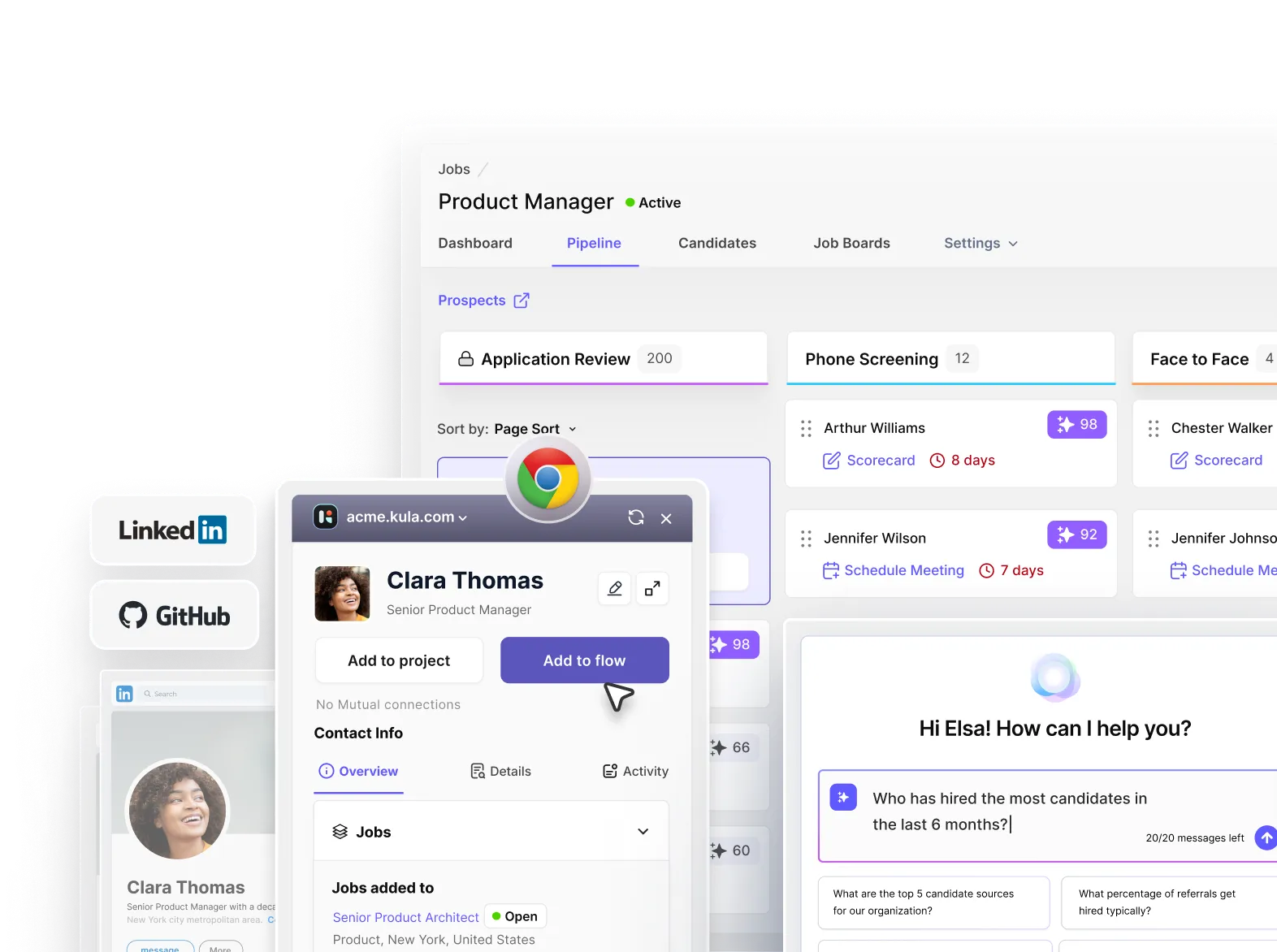
Kula is an AI-native recruiting platform designed to manage the entire hiring process from sourcing to offer rollout. Unlike Lever, which often relies on integrations and add-ons as recruiting needs become more sophisticated, Kula includes many of these capabilities natively within the platform.
I really like how deeply AI is embedded throughout the recruiting workflow.
Most ATS platforms treat AI as a standalone feature for sourcing or note-taking. Kula takes a different approach.
AI is integrated into candidate screening, scheduling, interview intelligence, analytics, reporting, and recruiter workflows, which means recruiters spend less time switching between tools or manually managing administrative tasks.
The biggest difference between Kula and Lever is how information flows through the system.
Candidate sourcing activity, interview recordings, feedback, candidate scores, recruiting KPIs, scheduling data, assessments, and offer approvals all live within the same platform.
This creates a much more connected recruiting workflow compared to managing multiple tools and integrations across the hiring process.
I also found Kula noticeably stronger in scheduling and analytics.
While many recruiting teams still coordinate interviews manually or rely on separate scheduling tools, Kula includes interview scheduling natively. Candidates can self-schedule based on interviewer availability, while the system automatically accounts for interviewer workload, availability conflicts, and scheduling logistics.
The analytics experience is also very different. Instead of building reports manually, recruiters can ask questions in natural language and instantly access recruiting metrics, hiring funnel insights, and operational data through conversational AI analytics.
In case you’re planning to migrate your data to Kula from Lever, you can do this very seamlessly using an API key.
Key features:
- AI scoring for candidate evaluation: Recruiters define role-specific criteria such as skills, qualifications, and experience. Kula automatically scores and ranks applicants against those requirements, helping teams review applications faster and more consistently.
- Built-in interview scheduling: Candidates can self-schedule interviews based on interviewer availability. The platform automatically prevents scheduling conflicts and reduces manual coordination.
- Interview intelligence and AI note-taking: Interviews are recorded, transcribed, summarized, and converted into structured feedback. Scorecards can be automatically populated based on interview conversations.
- Conversational analytics and reporting: Recruiters can ask hiring questions in plain English and receive immediate insights without building dashboards or exporting data.
- Automated candidate outreach: Run personalized outreach campaigns across email and LinkedIn while tracking all engagement within the candidate profile.
- Offer management and approvals: Generate, approve, and send offer letters through integrations with DocuSign and PandaDoc without leaving the platform.
Pros:
- Combines ATS, CRM, sourcing, scheduling, interview intelligence, analytics, candidate evaluation, and offer management into one platform
- Conversational AI analytics removes the need for manual report building
- Built-in interview scheduling eliminates the need for separate scheduling software
- AI scoring helps recruiters review applicants faster
- Reduces dependency on third-party recruiting tools and integrations
Cons:
- Newer platform compared to legacy ATS providers like Lever
Pricing:
- $4,800/year for 1-50 employees. All features included in every plan with head count based pricing—no tier based plans.
G2 rating: 4.5/5
Why choose Kula over Lever?
- Native interview scheduling instead of relying on additional tools
- Transparent pricing with no additional costs
- Interview intelligence with built-in recording, transcription, summaries, and scorecards
- More recruiting functionality available out of the box without requiring multiple add-ons
Bottom line:
Kula is a strong Lever alternative for teams that want more than an ATS and CRM.
It's particularly well suited for organizations looking to consolidate sourcing, scheduling, candidate evaluation, interview intelligence, analytics, and offer management into a single AI-native recruiting platform rather than stitching together multiple recruiting tools.
Plus, the pricing is as transparent as it gets in the ATS market.
3. Greenhouse
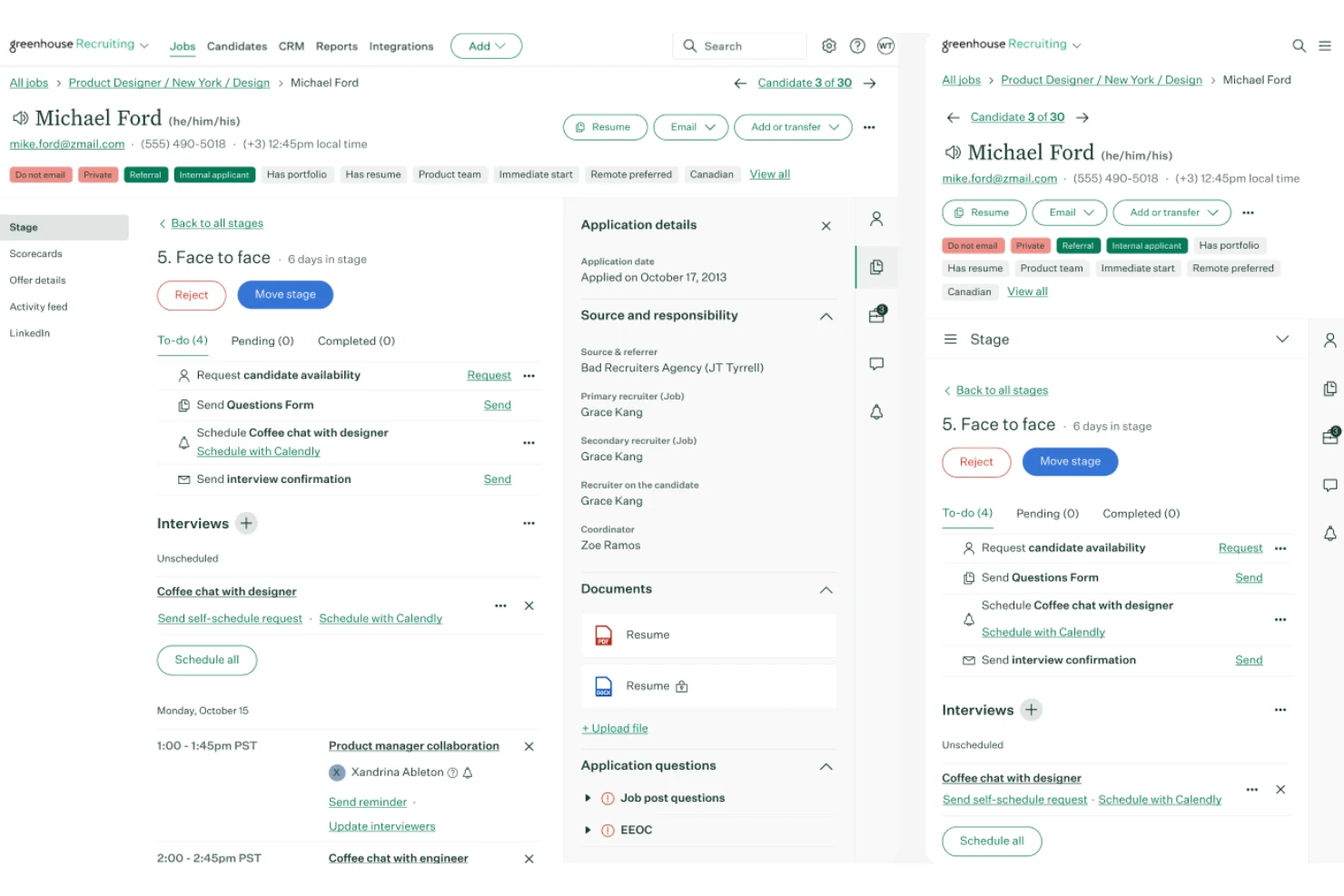
Compared to Lever, Greenhouse places a much heavier emphasis on structured hiring. The platform is designed around creating repeatable hiring workflows where candidates are evaluated against predefined scorecards, interview plans, and hiring criteria rather than interviewer intuition alone.
More importantly, it’s a great alternative to Lever if you’re looking for a platform that ties into your overall HR process.
One of the challenges many larger organizations face is maintaining consistency across recruiters, hiring managers, and interviewers.
Different interviewers often evaluate candidates differently, which can make hiring decisions harder to standardize. Greenhouse addresses this through interview kits, scorecards, hiring plans, structured interview frameworks, and candidate debrief workflows that keep teams aligned throughout the hiring process.
I also found Greenhouse particularly strong for recruiting operations teams.
The platform offers deeper workflow structure, permissions management, interview governance, and process standardization than many ATS platforms in the market. For organizations hiring across multiple departments, regions, or business units, that level of consistency can become a major advantage.
Greenhouse has also expanded its AI functionality significantly over the last year, including AI-generated interview plans, scorecard recommendations, interview summaries, and candidate review assistance.
That said, Greenhouse can feel more process-heavy than Lever. Some smaller teams may find the structured approach beneficial, while others may feel it introduces more operational complexity than they actually need.
Key features
- Structured hiring workflows with interview kits and scorecards
- Consolidate the hiring tech stack from sourcing to onboarding
- AI-generated interview plans and hiring recommendations
- Advanced recruiting analytics and reporting
- Large integrations marketplace with hundreds of recruiting tools
Pros:
- One of the strongest structured hiring platforms available
- Excellent interview scorecard and evaluation workflows
- Strong recruiting operations and governance capabilities
- Scales well across larger hiring organizations
- Extensive integrations ecosystem
Cons:
- Higher learning curve than many SMB-focused ATS platforms
- Can feel process-heavy for smaller recruiting teams
- Users report high cost for small to medium sized teams
- Often requires more implementation planning than simpler ATS platforms
Pricing:
- Custom pricing only
G2 rating: 4.4/5
Why choose Greenhouse over Lever?
- Stronger structured hiring methodology
- Consolidates HR process with recruiting workflows
- Better suited for organizations focused on hiring consistency and governance
Bottom line:
Greenhouse is a strong Lever alternative for organizations that prioritize hiring consistency, interview quality, and process standardization. It's particularly well suited for larger teams that want structured hiring frameworks that consolidate with their overall HR functions, rather than a sourcing-first recruiting workflow.
4. Workable
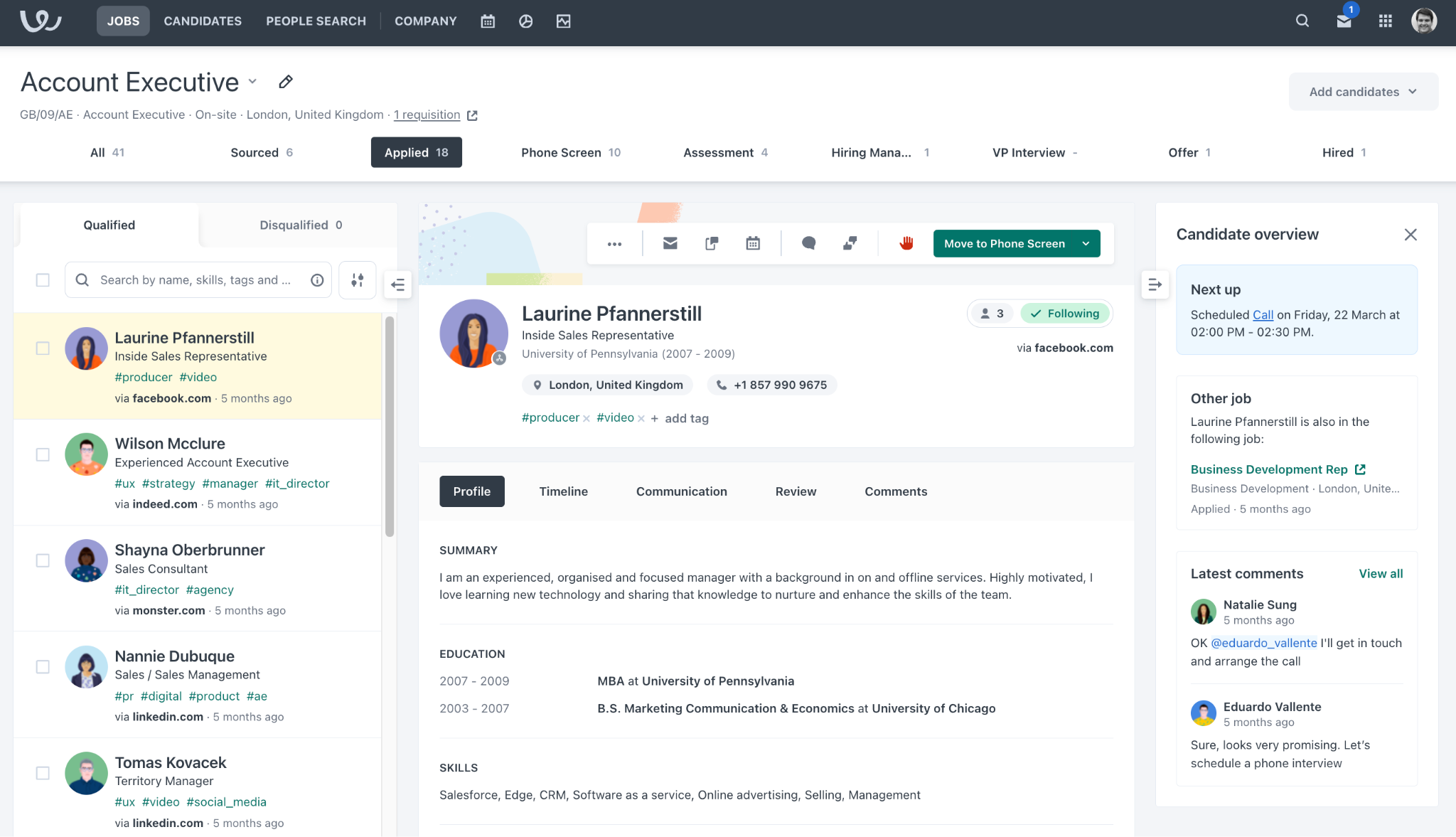
Compared to Lever, Workable feels much more focused on simplicity.
While Lever leans heavily into ATS + CRM workflows, candidate nurturing, and recruiting operations, Workable is designed for teams that want to start hiring quickly without spending months configuring workflows or training hiring managers.
One thing I noticed while researching recruiter feedback is that many teams choose Workable because of its low learning curve.
The platform combines applicant tracking, sourcing, interview scheduling, job posting, candidate communication, and HR functionality into a relatively straightforward interface that most hiring teams can adopt quickly.
Workable has also expanded its AI capabilities significantly over the last few years.
The platform now includes AI-generated job descriptions, candidate screening assistance, sourcing support, interview question generation, and other AI-powered recruiting workflows designed to reduce recruiter workload.
That said, several reviewers mention that costs can increase once teams begin adding premium functionality such as texting, assessments, video interviews, and other advanced recruiting features.
Where Workable can start feeling limited is recruiting complexity.
Organizations running sophisticated sourcing strategies, highly customized workflows, large-scale recruiting operations, or advanced analytics programs may eventually outgrow its flexibility and reporting capabilities compared to platforms like Lever, Ashby, or Greenhouse.
Key features:
- AI-generated job descriptions and hiring content
- Candidate sourcing across 200+ job boards
- Interview scheduling and hiring workflows
- Built-in HR and employee management functionality
- Candidate screening and talent sourcing tools
- Reporting dashboards and hiring analytics
Pros:
- Easy to learn and implement
- Strong job distribution and sourcing capabilities
- Built-in HR functionality beyond recruiting
- Good fit for smaller teams without dedicated recruiting operations support
- Large integrations ecosystem
Cons:
- Advanced functionality often requires add-ons
- Reporting can feel limited for more data-driven recruiting teams
- Less customizable than platforms like Ashby or Greenhouse
- Can become expensive as additional features are added
- Less sophisticated CRM functionality than Lever
Pricing:
Paid plans start at $299/month with a free 15 day trial.
G2 rating: 4.4/5
Why choose Workable over Lever?
- Faster setup and easier onboarding
- More transparent pricing
- Lower learning curve for hiring managers
- Built-in HR functionality
- Better fit for teams that mainly focus on inbound hiring
Bottom line:
Workable is a strong Lever alternative for smaller organizations that want a straightforward hiring platform without the complexity of a more operations-heavy ATS. It's especially useful for teams that prioritize ease of use, quick implementation, and HR functionality alongside recruiting.
However, organizations focused on outbound recruiting, talent pipeline management, and more advanced recruiting workflows will likely find Lever more scalable over time.
5. Ashby
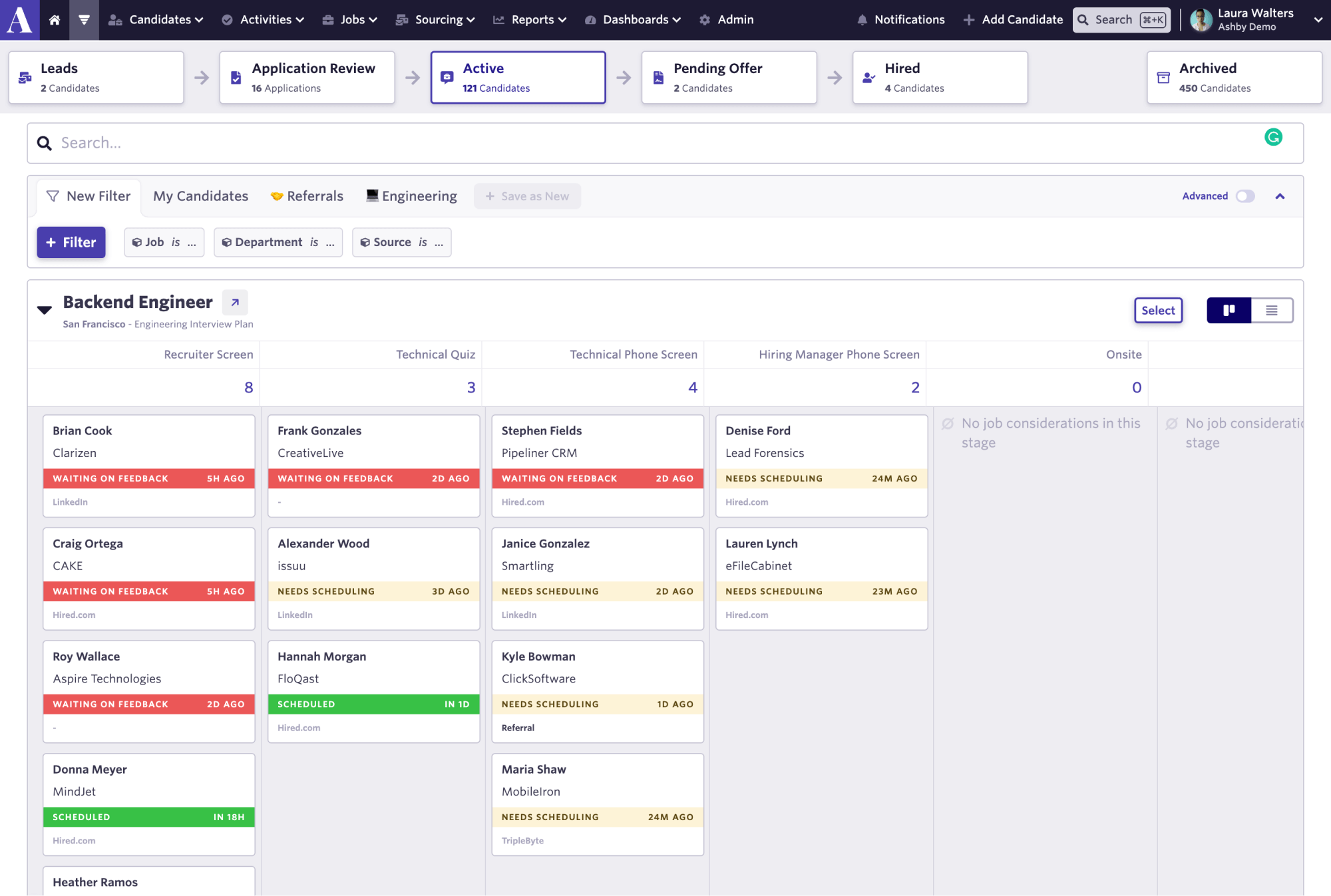
Compared to Lever, Ashby gives teams significantly more control over how their hiring process is designed, measured, and managed. The platform combines ATS, CRM, scheduling, sourcing, and analytics into a single system, but what really differentiates it is the depth of customization available throughout the platform.
One thing that stood out to me while researching Ashby is how often recruiters mention analytics.
Many ATS platforms offer dashboards and reports, but Ashby treats analytics as a core product rather than an add-on feature.
Recruiters can build highly customized reports, track funnel conversion rates, analyze source effectiveness, measure interviewer performance, and create dashboards tailored to different stakeholders without relying heavily on spreadsheets or external tools.
Ashby also gives teams far more flexibility when it comes to workflows.
Interview processes, permissions, scorecards, recruiting stages, approval chains, scheduling workflows, and reporting structures can all be customized to match the way an organization hires rather than forcing teams into predefined workflows.
That flexibility is one of Ashby's biggest strengths, but it can also make the platform feel more complex than Lever for teams with straightforward hiring needs.
Key features:
- Customizable ATS and CRM workflows
- Advanced recruiting analytics and dashboard builder
- Interview scheduling and coordination
- Candidate sourcing and pipeline management
- Custom scorecards and hiring processes
- Recruiting operations-focused workflow automation
Pros:
- Some of the strongest recruiting analytics available in an ATS
- Highly customizable workflows and permissions
- ATS, CRM, analytics, and scheduling in one platform
- Scales well for fast-growing hiring teams
Cons:
- More complex than many SMB-focused ATS platforms
- May be overkill for smaller recruiting teams
- Steeper learning curve than tools like Workable or BreezyHR
- Pricing is not publicly available
Pricing:
- Pricing scales as per the size of your team. For 1-10 employees, paid plans start at $300/month. For teams with over 100 employees, contact the team for pricing.
G2 rating: 4.7/5
Why choose Ashby over Lever?
- More advanced reporting and analytics
- Greater workflow customization
- Stronger recruiting operations functionality
- Better visibility into hiring performance
- More flexibility for complex hiring processes
- Stronger AI features at each step of the workflow
Bottom line:
Ashby is a strong Lever alternative for recruiting teams that view hiring as an operational function rather than simply a recruiting process. It's particularly well suited for organizations that need deeper analytics, workflow flexibility, AI features, and recruiting operations capabilities than Lever typically provides.
- JazzHR
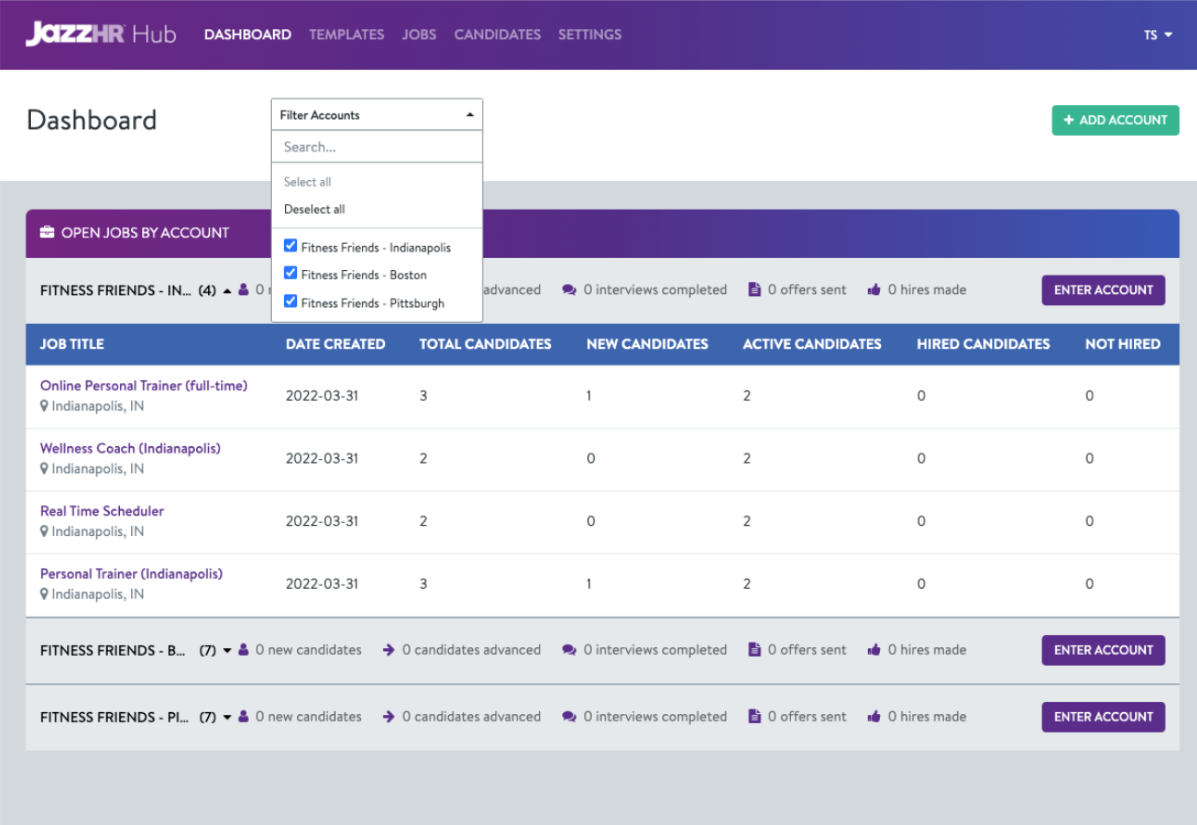
JazzHR has been a popular ATS among smaller hiring teams for years because it focuses on doing the basics well.
While Lever combines ATS and CRM functionality and supports more advanced recruiting workflows, JazzHR is primarily focused on applicant tracking, interview management, candidate communication, and collaborative hiring. For many small businesses, that's exactly what they need.
One thing I noticed while reviewing recruiter feedback is that ease of implementation comes up repeatedly.
Many teams adopt JazzHR because they can get up and running quickly without dedicated recruiting operations support, extensive training, or a lengthy implementation process. The platform is generally viewed as intuitive, straightforward, and relatively easy to manage for companies with lower hiring volumes.
But the tradeoff is scalability.
As hiring complexity increases, recruiters often mention limitations around reporting, workflow customization, automation, and advanced recruiting capabilities. Teams that start hiring across multiple departments, require deeper analytics, or need more sophisticated sourcing and CRM functionality frequently begin evaluating alternatives.
Key features:
- Applicant tracking and candidate management
- Custom hiring pipelines
- Interview scheduling and team collaboration
- Strong job board distribution and candidate sourcing
- Candidate communication tools
Pros:
- Easy to implement and learn
- Affordable compared to many ATS platforms
- Straightforward user experience
- Good fit for smaller teams
- Supports collaborative hiring workflows
Cons:
- Limited reporting and analytics features
- Less workflow customization than many modern ATS platforms
- Fewer advanced automation capabilities
- Can feel restrictive as hiring operations mature
- Less sophisticated CRM functionality
Pricing:
- Hero plan starts around $110/month.
G2 rating: 4.4/5
Where Lever still has the edge
- Built-in CRM functionality
- Stronger sourcing and candidate nurturing workflows
- More advanced automation
- Better analytics and reporting capabilities
- Better suited for growing recruiting teams
Why choose JazzHR over Lever?
- Lower cost of ownership
- Faster implementation
- Easier for non-technical hiring teams to adopt
- Better fit for organizations with simpler hiring needs
- Less complexity for occasional hiring
Bottom line:
JazzHR is a solid Lever alternative for smaller businesses that want a straightforward ATS without the cost or complexity of a more advanced recruiting platform. However, organizations that expect hiring volume, recruiting complexity, or sourcing needs to grow over time will likely find Lever more scalable in the long run.
7. Jobvite
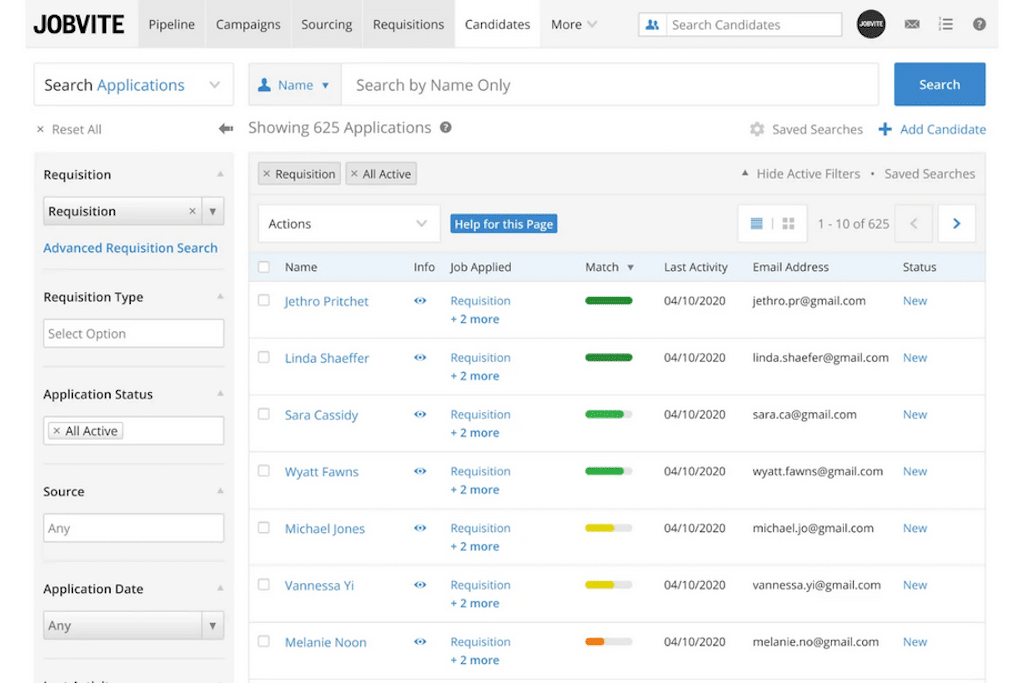
Jobvite combines ATS, CRM, employee referrals, career sites, and recruitment marketing tools into a single platform.
What stood out to me is that it places much more emphasis on attracting and nurturing candidates than many traditional ATSs, making it a common choice for larger companies running high-volume hiring programs.
That said, Jobvite can feel complex to configure and maintain. Several users mention that reporting, workflows, and the overall interface have a steeper learning curve than newer platforms.
Pros:
- Strong recruitment marketing and employer branding capabilities
- Built-in CRM, employee referrals, and internal mobility tools
- Suitable for high-volume and enterprise hiring teams
Cons:
- Steeper learning curve than modern ATS platforms
- Reporting and workflow customization can feel complex
Pricing:
Pricing available at request. Additional charges are required for add-on modules like candidate onboarding, AI companion, and recruitment marketing software.
G2 rating: 4/5
Why choose Jobvite over Lever?
Jobvite is a better fit for organizations that prioritize recruitment marketing, employer branding, and large-scale talent attraction programs. Lever's experience is generally simpler, while Jobvite offers a broader talent acquisition suite.
But if you're looking for a modern all-in-one ATS that combines sourcing, scheduling, AI screening, interview intelligence, and analytics in a single platform, Kula may be a better fit. Kula brings these capabilities together natively instead of relying on multiple add-ons or integrations.
How to choose the best Lever alternative
Not every team replaces Lever for the same reason.
Some need stronger reporting. Others want built-in AI, better scheduling, or a platform that doesn't require multiple add-ons to complete basic recruiting workflows.
Before comparing demos and pricing sheets, start with these five questions:
1. Identify what's missing in your current recruiting stack
The biggest mistake I see teams make is evaluating every ATS feature instead of focusing on the problems they're actually trying to solve.
For example:
- If reporting and analytics are your biggest frustration, look closely at Greenhouse, Jobvite, or Kula's conversational analytics.
- If interview scheduling requires too much manual coordination, evaluate platforms with native scheduling automation.
- If recruiters spend hours screening applications, prioritize AI-powered screening and candidate scoring capabilities.
- If you're juggling separate tools for ATS, CRM, scheduling, analytics, and interview intelligence, consider an all-in-one platform instead of another point solution.
The right alternative depends on the bottleneck you're trying to eliminate.
2. Match the platform to your hiring volume
A recruiting team hiring 20 people a year doesn't need the same platform as a team hiring 500.
Enterprise-focused tools often offer deeper customization and governance controls, but they can introduce additional complexity for smaller teams.
On the other hand, SMB-focused platforms may be easier to implement but can become limiting as hiring volume grows.
Choose a platform that supports where your organization will be in two years—not just where it is today.
3. Calculate the total cost, not just the subscription fee
ATS pricing can be misleading.
Many platforms charge separately for:
- Scheduling
- CRM functionality
- Advanced reporting
- AI features
- Assessments
- Onboarding
- Additional integrations
A lower starting price can quickly become more expensive once add-ons are included. When evaluating ATS vendors, calculate your expected cost based on the features you'll actually use.
4. Audit your integrations before making a decision
An ATS sits at the center of your recruiting tech stack.
Before committing, verify that the platform integrates with your:
- HRIS
- Background check provider
- Assessment platform
- Communication tools
- Calendar systems
- Job boards
Poor integrations create manual work, data gaps, and adoption challenges after implementation.
5. Evaluate how much work recruiters can automate
Most ATS vendors now claim to use AI. The more important question is: what work does the platform actually remove?
Look beyond marketing claims and evaluate whether the system can:
- Surface qualified candidates automatically
- Reduce manual screening
- Automate scheduling coordination
- Capture interview feedback
- Generate hiring insights without exporting data into spreadsheets
The best Lever alternative is the one that solves your biggest hiring challenges—not necessarily the one with the longest feature list.
If you're looking for an all-in-one, AI-native alternative to Lever that combines sourcing, ATS, CRM, scheduling, interview intelligence, analytics, and candidate communication in a single platform, book a demo with Kula and see how it can help streamline your entire hiring workflow.

When evaluating Lever alternatives, focus on four key areas: (A) Customization & flexibility- Does the tool offer flexible workflows, job posting formats, and custom reports? (B)Automation & AI support- Look for platforms with AI-powered sourcing, resume screening, and intelligent interview scheduling. (C)Ease-of-use- Consider platforms with a lower learning curve and user-friendly dashboards, especially if you're onboarding a non-technical team. (D)Integrations & scalability- Make sure the tool integrates with your existing HR tech stack and can scale with your company’s growth.
Kula is one of the best Lever alternatives for small businesses and startups looking to implement AI in their hiring workflows. Its easy-to-use and intuitive interface allows startups to get started quickly. It also serves as a complete ATS tool, offering advanced features for sourcing, interviewing, and analytics. To learn more, schedule a time to chat with our team.
Yes, most Lever alternatives provide migration support either through their onboarding team or third-party data services. All five alternatives offer dedicated implementation teams to ensure a smooth transition of data.